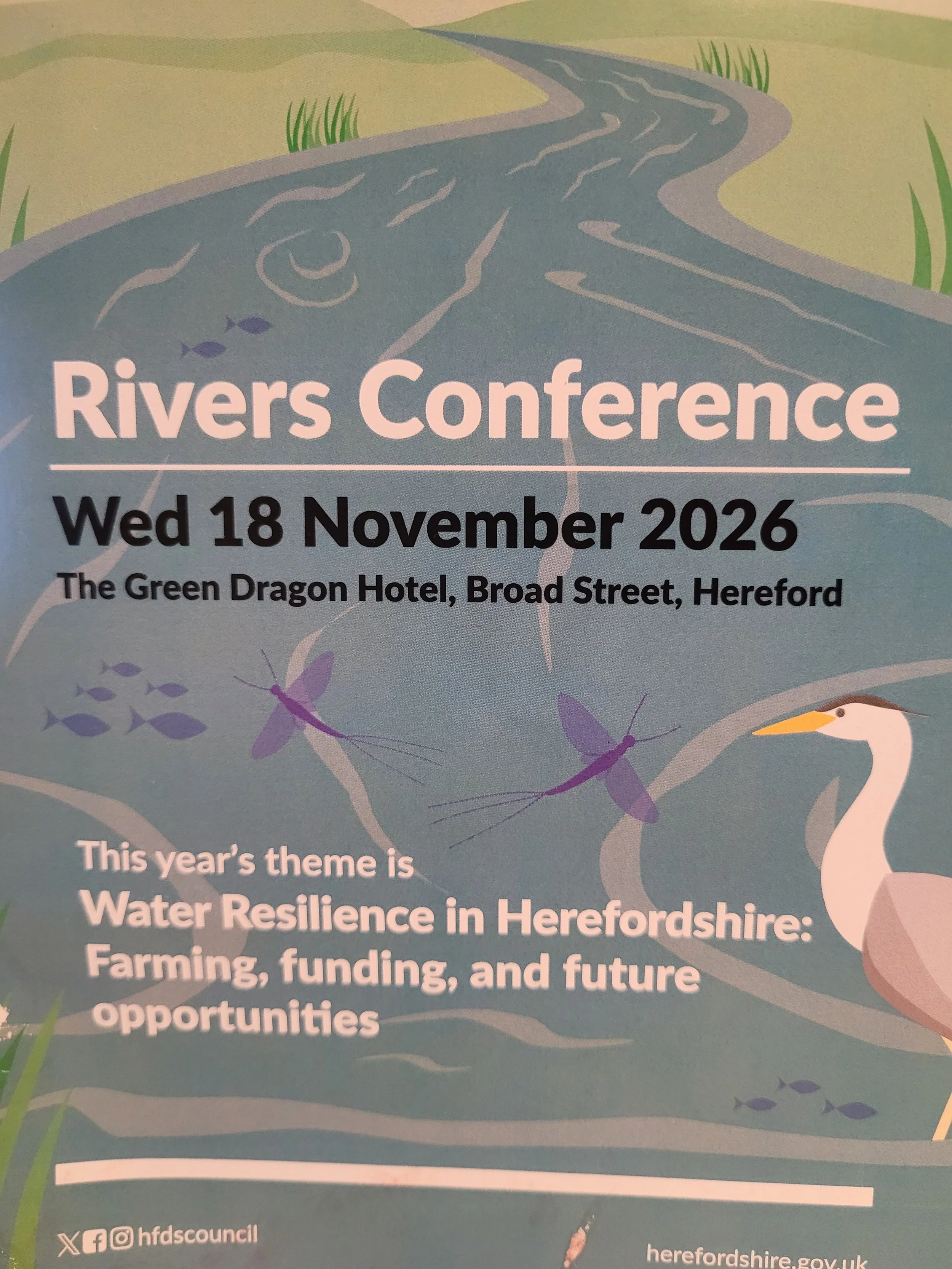
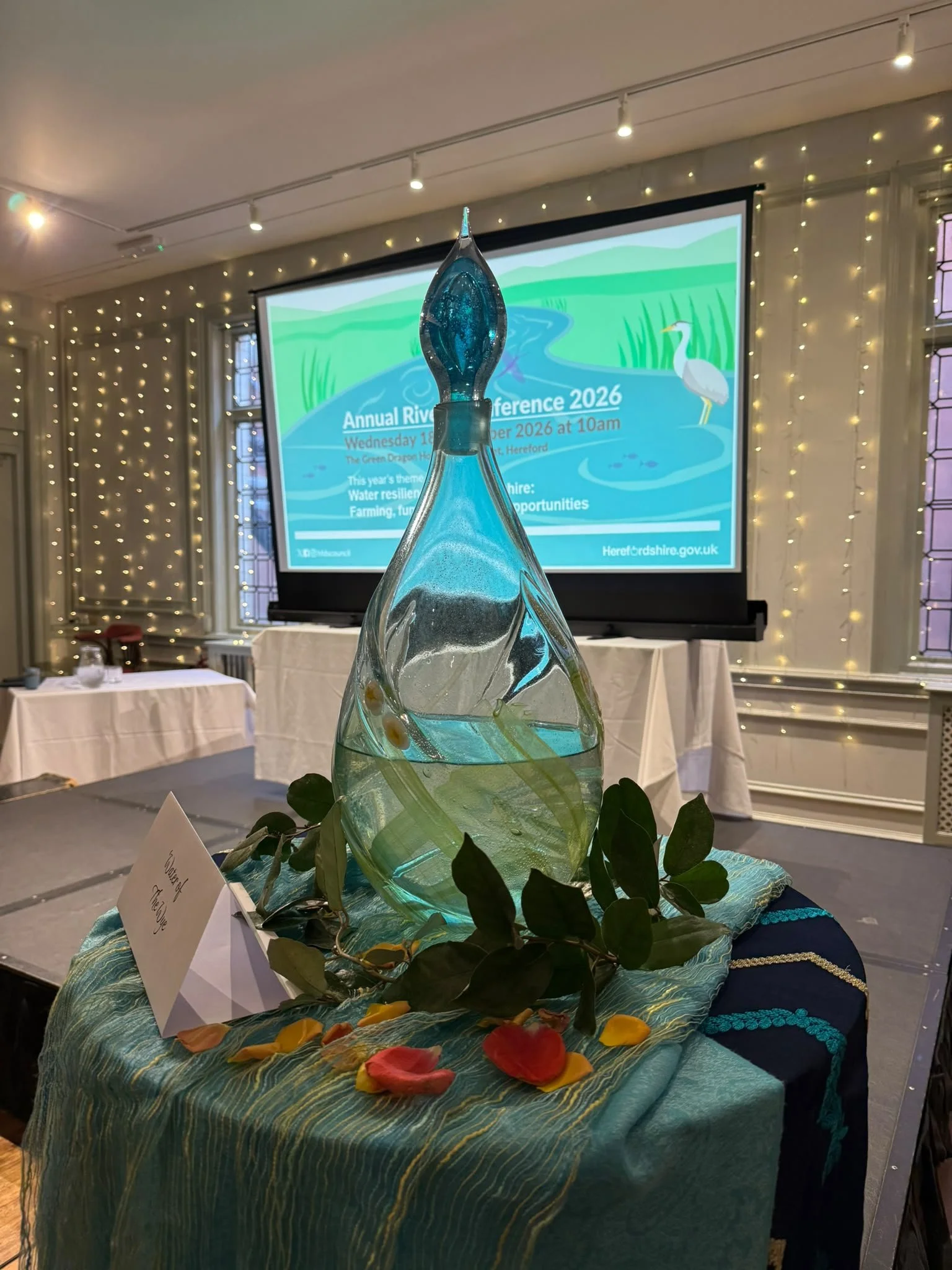
The Waters of the Wye at the Rivers Conference. Photo credit: Vey Straker.
As the Voice of the River I was pleased to give the opening speech at this years Rivers Conference, held on the 18th November at the Green Dragon Hotel in Hereford. For those unable to attend, this is what the Rivers had to say to land managers and farmers on water resilience in Herefordshire…
“Our climate has changed. Now extreme weather events, like rain heavy enough to cause flooding and droughts that last long enough to kill crops and cause wildfires, are our new normal. Our current ways of doing things need to change. Not just because they no longer work, but because they make the problems created by climate change much worse.
Crops don't die of drought just because it doesn't rain, it's also because they're grown on slopes that lose water quickly; in soil that lacks organic matter; in huge fields with no hedges to shade or shelter them, and no trees to cool the air and draw water from the deep soil layers. Flooding doesn't just happen because we have more rain now, it's also because of how we farm. Soil is compacted by overgrazing and heavy machinery; 60% of farm ponds have disappeared in the last 50 years; 90% of all lowland wetlands have been drained; water meadows converted to arable land; Rivers have been reduced to channels of water pinned between agricultural fields.
Restoring floodplains to rivers, pulling back from the edge of the channel to make space for water, allowing wet woodlands and habitats to resurrect themselves to hold and filter the water that enters the river, is very much a win-win solution which benefits farm businesses as well as everyone else. Farms that have done this are more resilient and able to cope with our extreme and unpredictable weather, because wetlands don't just store water within themselves, hydraulic gradients and capillary action move water sideways into the surrounding soils. Recreating farm wetlands, water meadows and marshy grasslands protects crops from drought; recharges aquifers; creates habitats; prevents wildfires; stops rainwater from charging into the river and slamming into the towns downstream, destroying homes and businesses. Recreating farm ponds provides reservoirs of free water, available for use when needed.
Floodplain reconnection and farm wetland restoration have benefits not just for farms but also for people living in vulnerable riverside towns, like Hereford, Monmouth and Ross on Wye. These habitats slow the flow and store millions of gallons of water.
Legally people own land. However, we cannot truly own something that existed for millennia before we did, and will exist for millennia after we are gone. Few people have the power to truly change the world, but landowners have that power. As old stories teach, with power comes responsibility - the ability to respond.
Across Britain one in six species are at risk of extinction and 83% of children are unable to recognise an oak tree. It is time to ask ourselves -
What is farmed land for? Is it solely to serve the interest of just one species or does it have a greater response ability than that?
Land managers have the unique ability to help in very practical ways…
Changes to grazing and cropping practises can regenerate soil and enable it to store vast quantities of carbon and water.
Land managers can restore ponds and wetlands.
Land managers can pull back from the edges of the river and allow the river to have a floodplain.
Land managers can ensure ditches flow into attenuation ponds which trap silt So the water flows clean off their land.
The solutions are relatively simple and well proven to work.
As the Voice of the River I ask you not just to rely on grant aid to do this work, but to use your power to restore the river and farm wetlands because it is the right thing to do. Farm wetland restoration is a win:win solution.”