Rivers are Born in the Mountains

Grazing sheep on Plylimon by James Allan. CC creativecommons.org
For millions of years, as both ice and river, I created and shaped this landscape, which has been home to humans for just 12,000 years. People brought sheep to graze my uplands just 4,500 years ago. Relatively recently upland grazing has begun to harm the hills where my rains fall and my waters are born.
Until just a few 100 years ago the uplands on which my rains fall, were made of blanket bogs, rainforests, heathlands, lakes, woodlands, meadows, and deep peat soils, but over time more and more domesticated grazing animals have been kept. Over the years, little by little, the native rainforests of the hills were changed into grasslands. George Monbiot recently described sheep as “a perfectly designed instrument of fully automated environmental destruction”, because as they roam the hills, they seek out the tastiest and most nutritious things to eat. Tree seedlings have lots of nutrients packed into them, so sheep seek them out. Even if you have very low numbers of sheep, you still ensure that no trees grow at all, because sheep scour the landscape looking for tree seedlings. They eat out almost all other plant species too, very few can survive the constant onslaught of grazing pressure. So sheep create monocultures of purple moor grass, Molinia, which is very coarse, dense, tussock-forming grass, perfect for wildfires, and the only thing which survives long-term intensive upland grazing.
In less than 100 years there has been a 500% increase in the number of sheep. Today there are so many sheep on the hills that they compact the soils and prevent my rains filtering into them. There are too many hooves on the hills. They crush the soil, squishing the spaces between soil particles where air and water live, compacted together the soil cannot absorb the rain as it falls. High places have high rainfall. The rain, which can't be absorbed into the compacted soils, rushes down the hills, and causes huge floods to everyone living downstream. This flooding isnt caused by climate change - its caused by land use change.
In nature, diverse herds of grazing animals follow weather patterns, eating and trampling, then moving on and not returning until the following year. Wild grazers don’t live on the hills in the harsh winter weather, they only visit in summer, grazing these high windy places for respite from biting flies. There are so few wild animals today, only 20Mt of wild mammals left on the planet, compared with 630Mt of domesticated mammals.
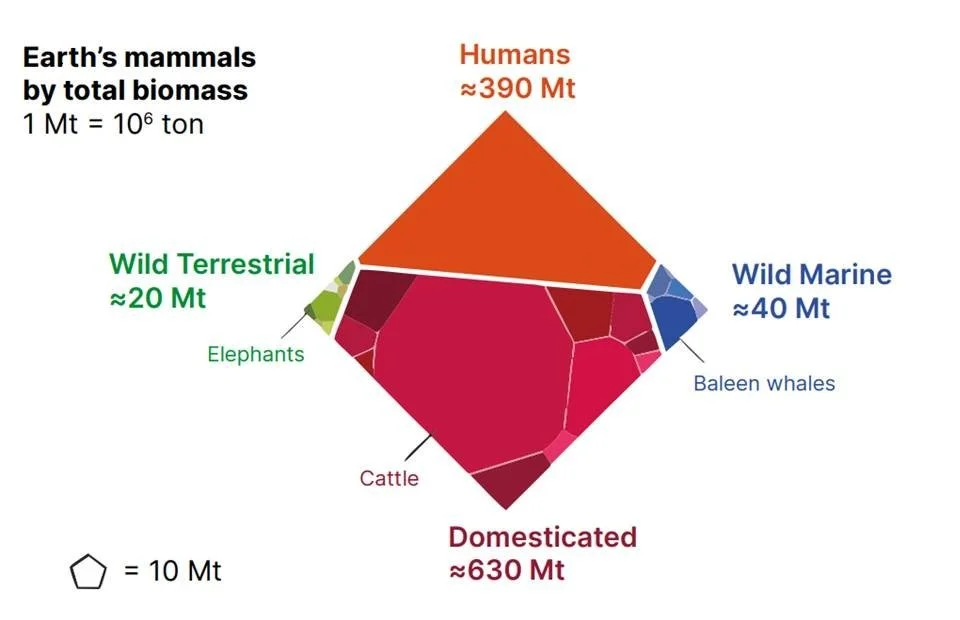
Earth Mammals by total Biomass reproduced by Greesnpoon et al. 2023 under CC BY_NC_ND 4.0 ©
Without trees covering the hills, their rich rainforest created soil is washed away, leaving just the rock and thin mineral soil, which can’t hold onto water. The hills are hard places for humans to farm. Upland farms are the least profitable farms, making farmers reliant on finanical support from the government known as ‘agricultural subsidies'. Without subsidies, many upland sheep farms would operate at a financial loss. Environmental destruction entirely caused by subsidy, funded by tax payers who don’t want to be flooded.
On the January 1st 2026, the Sustainable Farming Scheme on GOV.WALES officially replaced the old EU-era Basic Payment Scheme. Farmers are no longer paid simply for keeping sheep on the hills. If these changes mean that Welsh farmers, to switch from sheep to a more gentle and extensive traditional year-round grazing and browsing of native cattle, this would have similar benefits to those created by native mammals like aurochs and bison, which were long ago hunted to extinction in the UK. Native cattle can perform a very similar ecological function to aurochs, the ancestor of all modern-day domestic cattle. There is hope that new subsidy payments will focus on restoring peatlands, storing water in wetlands and healthy soils, and restoring diverse native vegetation via diverse native grazers and extensive grazing patterns, to enable the uplands, and rivers they birth to recover.
When human interests are balanced with the needs of other species, everybody thrives.
Restoration of upland landscape could create new opportunities for rural employment, in the UK 97% of rural dwellers are not farmers, only 3% are farmers, and rural employment is much needed. Wildlife tourism could draw people to Wales, just as it does everywhere else in the world. The return of native species like White tailed eagle, beaver, lynx, White storks and European bison could rejuvenate the failing rural economy and provide new opportunities for local people. The Welsh Rewilding Alliance is aiming to boost the rural economy and encourage young people to stay in rural Wales by creating meaningful, enjoyable job opportunities through rewilding and the return of Wales natural heritage.

Offa's Dyke passing through blanket bog by Roger Davies. CC creativecommons.org

