I’m Too Hot
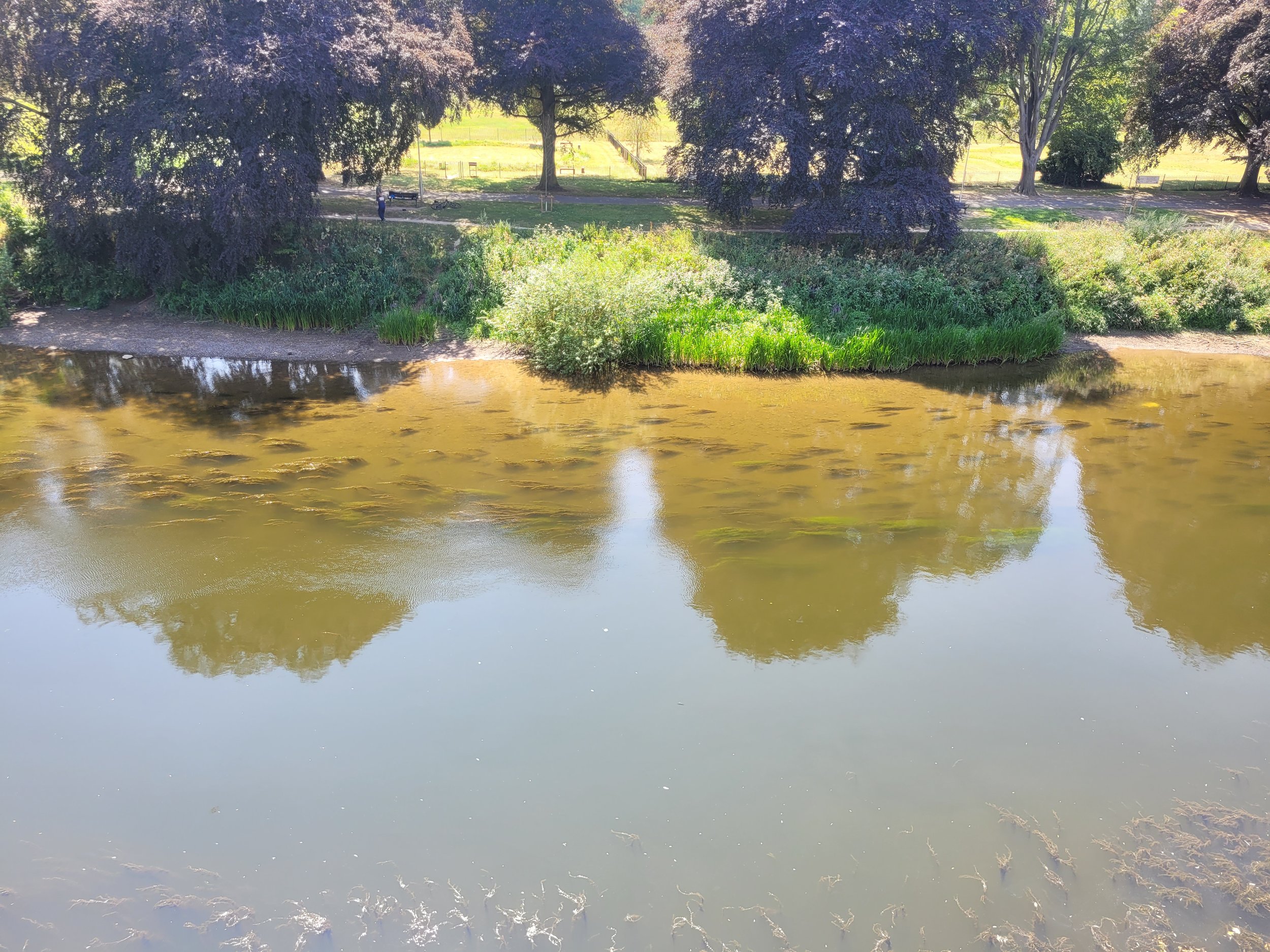
Algeal growth in warm low water in the Wye. Photo credit Louise Bodnar.
My waters are too hot. I can’t hold as much oxygen at high temperatures; my molecules have more energy at high temperatures; they move more rapidly; this breaks the bonds holding oxygen inside my liquid. The dissolved oxygen leaves the my waters evaporating into the air, and my warm waters are harder for oxygen from the air to dissolve into [1, 2, 3].
My fish have different needs for dissolved oxygen. For Atlantic salmon and Brown trout the ideal levels are above 9 mg/L (65–70% oxygen saturation). They experience severe stress if oxygen levels drops below 5 mg/L. [1, 2, 3] Barbel, Pike and Chub require oxygen above 7 mg/L. My warm low-flow condition is putting them at high risk [1, 2]. Roach, Dace, Bream are most tolerant of low oxygen levels, but need above 7 mg/L for optimal health, though survival is possible down to 3 mg/L before critical distress sets in [1, 2].
Warm water creates many problems for fish – in warm water fish's metabolic oxygen demand doubles, because heat speeds up internal chemical and biological processes [1, 2, 3, 4]. Fish metabolism increases in warmer water, because higher temperatures give their body molecules more kinetic energy, causing cellular functions and biochemical reactions to run at much quicker rates [1, 2, 3, 4]. Fish are ectotherms, animals in which internal physiological sources of heat, such as blood, are important in controlling body temperature. This means that their core body temperature matches the surrounding water [1, 2]. They cannot change this or escape the heat of the water; their resting metabolic rate is tied to the temperature of the water they are in. This means their internal organs—like the heart and gills—must work harder and faster to circulate blood and process nutrients; which requires a continuous, larger supply of oxygen – this is why they need twice as much oxygen in warmer water.
Yet horrifyingly, as my water warms it holds less and less oxygen [1, 2] . This creates a dangerous mismatch where the fish’s internal demand skyrockets while the external environmental supply shrinks [1, 2]. This causes immediate risks for the fish to survive, but it also cause longer term problems for those that survive the heat waves.
Warmer waters also increase rates of “protein denaturation” which forces fish to stop growing at earlier life stages*. Research has investigated the impact of high water temperatures on Salmon, and discovered “accelerated smoltification” [1, 2]. In Rivers like me, which are suffering low flow and high temperature, the warmer water is increasing juvenile metabolic rates, causing young salmon to smolt after just one year rather than the traditional two. This means Salmon smoults are younger and smaller when they leave for the sea. Its heart-breaking, as a River my purpose is toenable life– yet when my waters are warm I can not do that – the Salmon smoults leave my waters after just one year, and most do not survive at sea [1]. Research confirms that smaller salmon smolts have lower survival rates at sea compared to larger smolts. Larger body length and better physical condition help young salmon swim faster, avoid predators more easily, and better handle the energy demands of adjusting to saltwater [1].
In the past my landscape was full of wetlands; ponds, pools, marshes, bogs, fens, swamps and wet grasslands. During the 18th and 19th centuries extensive sub-surface and under field drainage was carried out to maximize hay and crop yields [1, 2], much of it funded by government and supported by government policy. In the 1920’s the formation of the River Lugg Drainage Board under the Land Drainage Act of 1918, systematically cleared main rivers and straightened channels to force faster runoff [1]. The 1970s were the peak of modern mechanical field-drainage era across my lowlands. All together, my catchment has lost 90% of its historic wetlands for farming and rural growth [1]. All summer long those wetlands fed me and my sister tributaries, water trickling through the soil layers and aquifers – preventing droughts on agricultural land and feeding the rivers, keeping us cool and topped up, even when there was no rain.
Today the whole of the UK is less than 3% wetland. There are precious few wetlands left to feed and cool the rivers through the summer.
Agriculture has changed too over this time, where once there were hay meadows, horses and people, now there are machines weighing many tonnes – crushing the living soil, squashing together the tiny pore spaces between soil particles which allow it to be full of air and water [1, 2, 3]. Compacted soil and soil low in organic matter can’t hold much water, every 1% increase in soil organic carbon equates to a water holding capacity increase of 354,000 litres a hectare to a depth of 30cm.*
Humus is the stable form of soil organic matter derived from decomposition of plant and animal substances, it stores three to five times its own weight in water. Farm fertilizer used to be muck and straw, which creates soil humus, but now the most common fertilizer used in my catchment is synthetic fertiliser ammonium nitrate, or locally abundant poultry manure from intensive livestock units [1, 2, 3]. Synthetic fertilizers do not add any humus to the soil [1, 2]. So not only have my wetlands been drained, the majority of the land in my catchment is agricultural land and most of those soils are now heavily compacted, with little humus; unable to store as much water as they used to; unable to feed me through the summer. Sadly but unsurprisingly farmers are struggling to keep crops alive in these compacted fields, depleted of soil humus and devoid of wetlands. The NFU blames climate change and urges the government to act*.
Certainly climate change is part of the problem, before humanities burning of fossil fuels caused the delicate balance of earth’s climate to break down and forced the misery of climate change upon us all, reliable and frequent summer rains allowed farming to carry on successfully; compacted soils were ploughed to break them up, and chemical fertilizers boosted plant growth despite the loss of humus from the soils, but not anymore. Climate change combined with these unsustainable farm practices = drought conditions and crop losses.
Environment Agency river gauge data shows my water levels have fallen to one of my lowest recorded levels; the Belmont monitoring station showing a reading of just 12cm [1]. I am now just 1.8cm above the lowest level ever recorded, when I fell to 10.2cm during the drought summer of 2022.*
River water levels across Herefordshire are exceptionally low due to official drought conditions, with the River Wye hitting near-zero readings at multiple gauges and prompting widespread fishing suspensions alongside environmental concerns. [1, 2, 3, 4]
Current River Wye Readings*
Hereford Old Bridge: Reading at 0.00m (or roughly 12cm at Belmont), sitting just millimeters above historical low records set in 2022.
Ross-on-Wye: Dropped to an extreme low of just 1cm.
Other Wye stations: Measuring 23cm at Hay-on-Wye, 11cm at Bredwardine, and 33cm at Mordiford.
River Lugg: Critically low at Ford Bridge (5cm), though slightly higher further down at Leominster Upper Marsh (33cm) and Lugwardine (27cm). [1]
The Hereford and District Angling Association and Ross-on-Wye Angling Club have enforced strict fishing closures across stretches of the Wye to protect fish populations [2]. Anglers love fish and understand them well; local bylaws, voluntary club suspensions and agency guidance all ensure they act in the best interests of fish, despite the personal and financial losses this can cause. The Wye and Usk Foundation has asked canoeists to avoid canoeing in high water temperatures and heat wave conditions* because gravel bars on the river bed are exposed and vulnerable to damage as canoes are dragged over them; fish are congregating in the deepest remaining pools of water, they can be seen at the surface gasping for air when water oxygen levels are too low; the additional stress of having to avoid predators (this is how my fish perceive canoes moving towards them) increase the risks to their survival and can push them into less oxygenated waters. As mammals you are drawn to water during heat waves, sadly my fish have had no respite from canoeing disturbances, it is not regulated like fishing, requests can be made to respect the needs of the fish, but no controls are available.
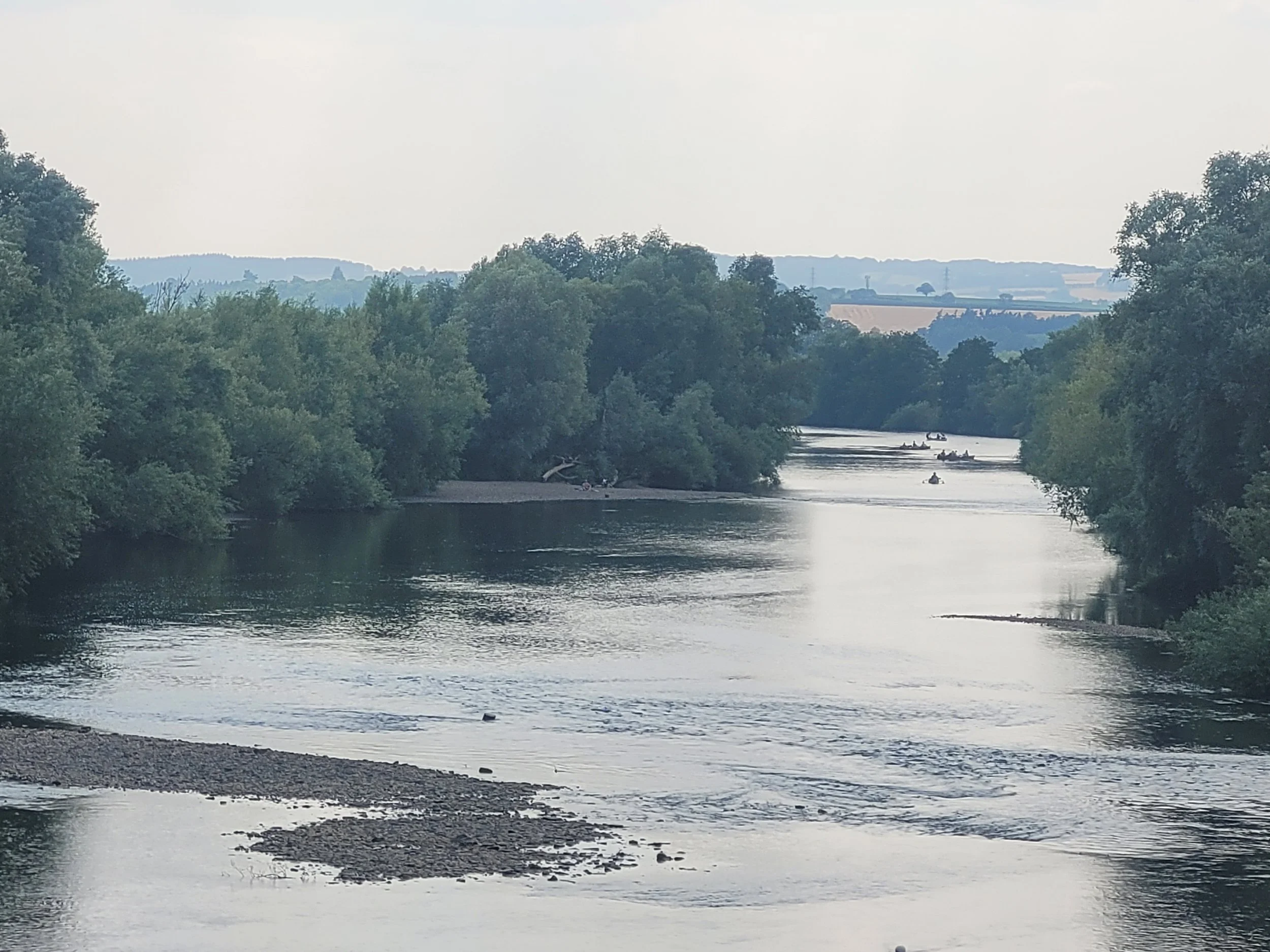
Low water levels on the Wye, still busy with canoes. Photo credit Louise Bodnar.
It gets worse for me, as summer heat waves and low flows accelerate algal growth and breakdown, which takes even more oxygen from my waters and creates pockets of dead water and lower dissolved oxygen over long stretches, which further endangers my fish populations.
Drought has been “officially declared” by the Environment Agency in Herefordshire, due to the low rainfall and persistently high temperatures. The Environment Agency reported that England received just 3% of its long-term average rainfall during the latest reporting period, while river flows, reservoir levels and soil moisture continue to decline. In Wales drought status was announced last week. Earlier this week, the Environment Agency described a second consecutive summer drought as an "exceptionally serious situation" for wildlife, farming and water supplies, while Natural Resources Wales said July was on course to become the driest July since records began 190 years ago, with just 8% of average rainfall recorded across Wales.*
Natural Resources Wales has said releasing additional water from the Elan Valley reservoirs into the Wye remains an option if conditions worsen, although the threshold for intervention has not yet been reached.
There is much we can all do to help The Waters in these drought conditions, as my friends at The River’s Trust explain in their blog here.
References
*https://waboost.com/blog/why-warm-water-holds-less-dissolved-oxygen
*EA Data available online: River Wye level at Old Wye Bridge https://check-for-flooding.service.gov.uk/station/4017
*“Too hot or too cold: the biochemical basis of temperature‑size rules for fish and other ectotherms” was published in Environmental Biology of Fisheshttps://doi.org/10.1007/s10641-023-01429-7
*[NFUonline](https://www.nfuonline.com/news/soil-organic-matter-and-increased-water-holding-capacity/),
*https://www.nfuonline.com/news/nfu-responds-to-drought-status-announcement/
*In a recent paper published in the journal Environmental Biology of Fishes, researchers explain “protein denaturation” intensifies when the waters in which fish live heat up. Protein denaturation takes place when proteins, which are essential components of living organisms’ cells and tissues, lose their original structure as a consequence of disruptions to the weak links that maintain their complex shapes – a common, spontaneous occurrence in most living organisms. One of the causes of such disruptions is heat, which increases the movement of water and protein molecules within cells, makes them bump against each other and results in the proteins losing their shape. The warmer the surrounding environment, the stronger the shocks and the more proteins lose their shapes. This is the ‘denaturation’ process. Proteins that have lost their shape do not fulfill their assigned role and, therefore, need to be resynthesized, so that the organism doesn’t fall apart. “As fish grow, more proteins are denatured. When the rates of denaturation and synthesis of new proteins become equal, then they stop growing,” said Dr. Daniel Pauly, lead author of the study and principal investigator of the Sea Around Us at UBC’s Institute for the Oceans and Fisheries. “The issue is that when their surrounding water is warmer than usual, the process of creating new proteins cannot keep up with the accelerated rate of denaturation caused by heat so fish have no other choice but to stop growing at an earlier stage so that both processes can balance each other out.” The process of resynthesizing proteins accelerates fish’s metabolism and, thus, they need more oxygen to sustain their body functions. Oxygen is key for the production of ATP and new proteins. The problem is that warmer waters contain less oxygen.
*https://www.herefordtimes.com/news/26424203.river-lugg-reopens-anglers-wye-still-shut-low-levels/?ref=ed_direct
* https://www.facebook.com/YourHfdshire/posts/news-the-wye-and-usk-foundation-urges-people-not-to-canoe-on-the-river-wye-amid-/1489621726534553/
