
Arable, Silt and Salmon
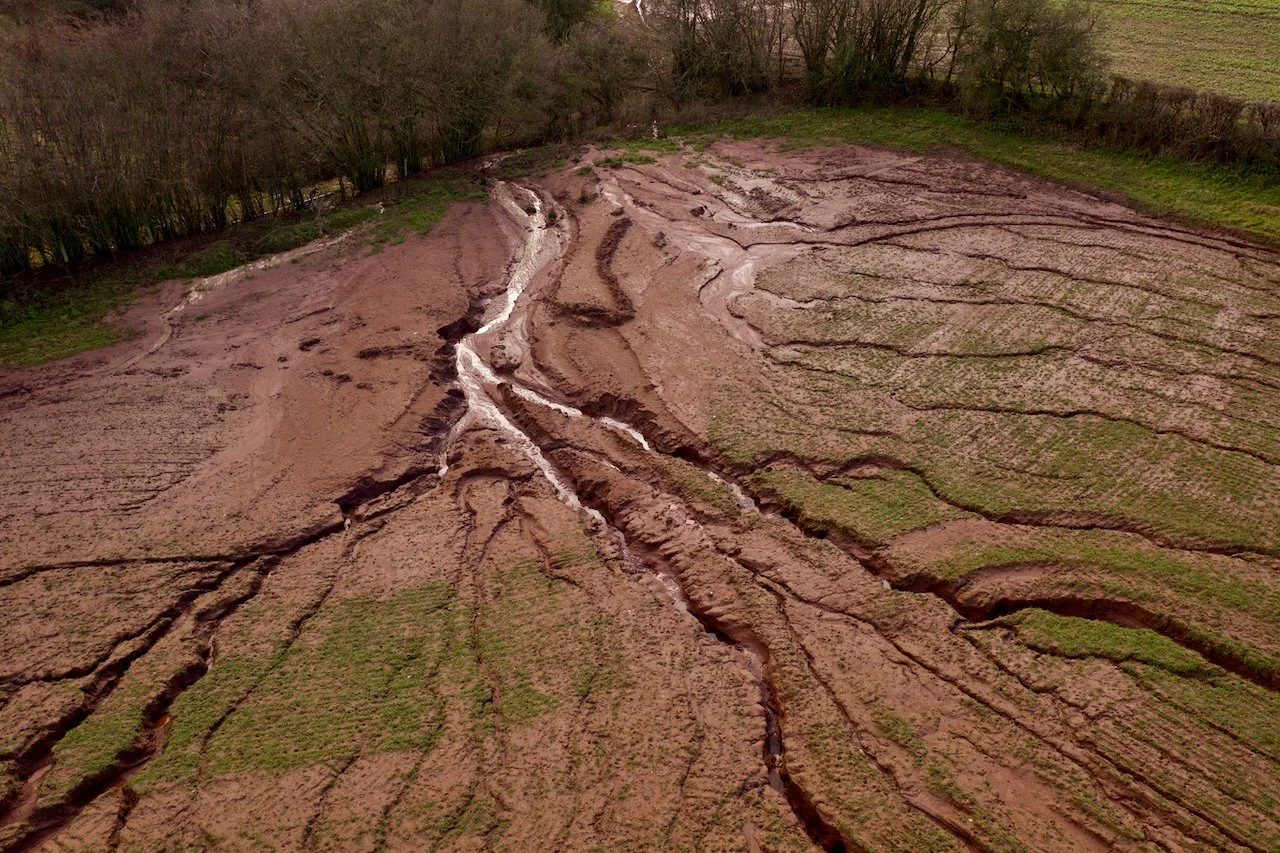
Soil entering the River Wye from adjacent arable field _ Environment Agency
My waters are polluted and unhealthy because soil and nutrients flow off agricultural land when it rains.
Especially when and where soil is left bare, or crops are grown on slopes. Herefordshire's fine sandy and silty soils make this problem worse. There are Farming Rules for Water, which dictate that soil must be retained on land, manure added should match crop needs, chemical fertilisers and manure should be kept out of rivers and streams. But these rules aren't working.
The rules aren’t good enough to protect my waters and they are poorly enforced. Every time it rains, more soil and fertiliser enters my waters. When soil enters water it becomes silt - fine particles which spread out and covering and smothering the river bed.
Today, my gravel beds are covered with silt. Fish like trout and salmon rely on my gravel beds to keep safe the eggs they lay. They use their bodies to create hollows in my gravel beds, into these they lay their eggs, then carefully cover their eggs with more gravel to create a tiny mound. My gravel must be clean, with well oxygenated water flowing over and between the tiny stones, for the eggs to get the oxygen they need from the water, to develop healthily and hatch into fish.
Now my gravels are covered with silt and algae, so the fish eggs developing within them, can't get oxygen from my waters. They are dying in their millions before they can hatch. Every year there are fewer salmon and trout in my waters.
Now my waters, once the best Salmon river on this island, are famed for Barbel; bottom feeding fish, that thrive by eating algae and dead fish eggs. Barbel can live in muddy, polluted waters, which are too dirty for trout and salmon.
There is nowhere else fish can lay their eggs, only river gravels. Yet, there are millions of acres away from rivers that could grow arable crops.
Under current laws 2m grass buffer strips are required at the edges of arable fields to protect rivers from fertilisers and manures. Extra payments within the Sustainable Farming Incentive, encourage 6-10m grass buffer strips along rivers, but even these can not protect me! The science shows that these buffers are too narrow. Much wider, 30-100m buffers are needed along rivers. Read more here, here and here.
Every year 3,000 tonnes more phosphate fertiliser than the crops and grasslands can use is spread on Herefordshire fields. This has gone on for so long it has created high levels of ‘legacy phosphate’, soils here have 60% more phosphorous than anywhere else in the country. So, when the rain falls on arable fields, soil and phosphate is carried into my waters, because arable crops are grown right next to my river channels, on steep slopes and there are no wetlands protecting the river channels and ditches by filtering water before they enter. Wetlands filter my waters, just as your kidneys filter your blood. Kidney failure kills. Without wetlands, I am as stricken as a patient on dialysis.
Legislative change is needed to protect rivers from agricultural pollution.
I am ancient and my memory is long. Those who love me have always had to fight to create laws to protect rivers...
In the 19th century UK Parliament was reluctant to create laws to deal with human waste. Many MPs opposed the high cost of sewage systems. Before the introduction of sewage legislation, the 1831–1832 cholera epidemic caused over 50,000 deaths, with widespread rioting. But it took another cholera epidemic, in 1848, with over 60,000 deaths, before the government introduced the 1848 Public Health Act, which finally began to reduce and control the release of human waste into rivers.
After that, it was industrial pollution that poisoned my waters. Again it took new legislation to protect my waters...
The 1876 Rivers Pollution Prevention Act, was the foundational, nationwide legislation that made it an offence to discharge solid or poisonous, noxious, or polluting liquid waste from factories or manufacturing processes into streams. Over the years this original act has been strengthened, in 1951 the Rivers Prevention of Pollution Act, replaced the 1876 Act and introduced a new system for maintaining or restoring the "wholesomeness" of rivers. The legislation was strengthened again in 1961 and 1974, after public campaign work, to covering all discharges and introducing much stricter, comprehensive regulation of industrial and sewage effluent.
Agriculture is currently subject to different, less stringent, environmental regulations than other industrial sectors. Its time for new laws and legislation to protect rivers from agricultural pollution, ensure arable farming is not directly adjacent to rivers and ditches flow into sediment ponds not streams.
